
70 Common Polish Phrases Every Foreigner Must Know (+ A Native Teacher's Honest Tips)

Updated: 4 days ago
Learn 70 common Polish phrases with cultural tips, pronunciation advice, and the mistakes foreigners actually make from a native Polish teacher.

Whether you’re flying to Warsaw next month, trying to impress your Polish in-laws at Sunday dinner, or you’ve just decided that today is the day you finally tackle a Slavic language... you’re in the right place.
I’m Karolina, and I spend my days teaching Polish to people just like you. I’ve seen exactly where students trip up, which words make them twist their tongues in knots, and, most importantly, which phrases actually open doors in Poland. This isn't just a dry list of words pulled from a 1990s travel guide. This is the real Polish that we use on the streets, in the shops, and at the dinner table.
Most guides give you a translation and wish you luck. In this guide, I’m giving you the cultural cheat codes and pronunciation secrets that usually take months of lessons to learn. Let’s get you talking.
The 15 Most Common Polish Phrases (Start Here)
If you only have five minutes before your plane lands, these are the heavy hitters. Master these 15, and you can navigate about 80% of basic daily interactions in Poland.

💡 Want to learn more ways to say hi in Polish? Check out my article on 15 different ways to say hello in Polish. |
How to Greet Someone in Polish and When to Use Which
In English, "Hi" works almost everywhere. In Polish? Not so much. We take our registers (the level of formality) quite seriously.
Formal Greetings (The Safe Zone)
Dzień dobry: Good morning / Good afternoon. Use this from sunrise until about 6:00 PM.
Dobry wieczór: Good evening. Use this once it’s dark or late afternoon.
Do widzenia: Goodbye. The standard way to leave a shop, office, or taxi.
Dobranoc: Goodnight. Specifically used when someone is actually going to sleep.
Informal Greetings (Friends & Family)
Cześć: Hi / Bye. It’s the Swiss Army knife of Polish greetings.
Hej / Hejka: Hey. Very casual, common among younger people.
Na razie: See ya / Bye for now.
Pa / Pa pa: Bye-bye. Very common, especially on the phone.

👩🏼🏫 TEACHER'S NOTE: The formal/informal split in Polish is more serious than in English. If you say Cześć to your boss, an older stranger, or a government official, it signals a lack of respect, even if you're smiling! We use a system called Pan (Sir) and Pani (Madam). When in doubt, default to Dzień dobry. You can always switch to Cześć once someone invites you to be informal. |
Are you just starting to learn Polish? Are you moving or traveling to Poland soon?
If so, I've put together a list of must-know expressions that’ll help you chat with the Poles like a pro (or at least like someone who knows how to ask for the bathroom).
Polish Polite Phrases: Dziękuję, Przepraszam, and Everything In Between
Polish culture values courtesy, even if we don't always do the "American-style" customer service smile. Using these phrases will change the way people treat you instantly.
Dziękuję: Thank you. (The big one!)
Dzięki: Thanks. (Informal)
Proszę: Please / Here you go / Come in. (The most versatile word in the language).
Proszę bardzo: You’re very welcome.
Nie ma za co: Don’t mention it.
Nie ma sprawy: No problem / No big deal.
Z góry dziękuję: Thank you in advance.
Przykro mi: I’m sorry (Expressing sympathy or regret).

👩🏼🏫 TEACHER'S NOTE: "Przepraszam" does double duty in Polish. It means both "excuse me" AND "I’m sorry." But "przykro mi" also means "I'm sorry"! So, what's the difference? If you bump into someone: przepraszam. If you want to get a waiter’s attention: przepraszam. But if something serious happened and you’re genuinely apologizing for a mistake, reach for przykro mi instead, as it carries more emotional weight. |
How to Ask "How Are You?" in Polish in Different Ways
In English, "How are you?" is basically a greeting. You say "Good, thanks" and move on. In Poland, if you ask how someone is, prepare for the truth!
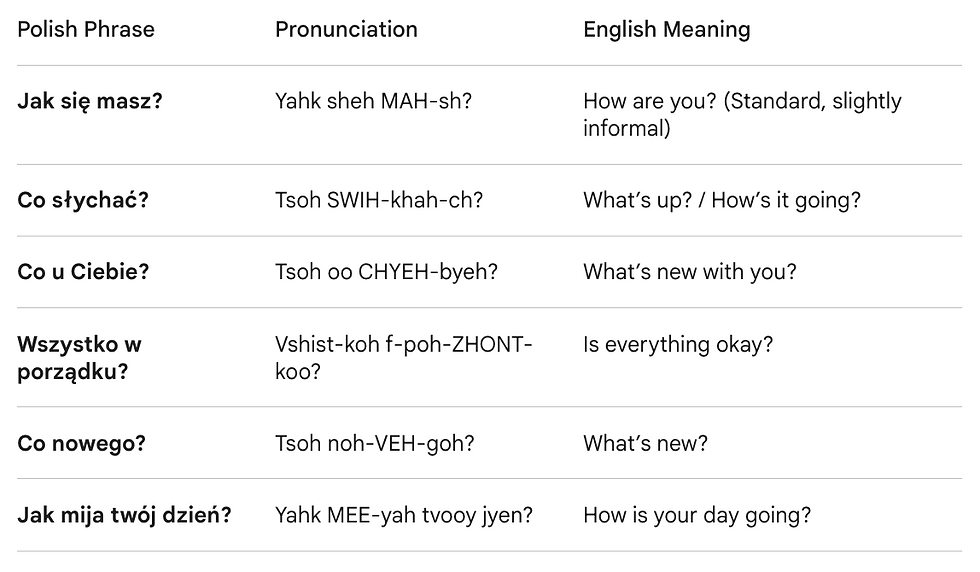
Jak się masz?: How are you? (Standard, slightly informal).
Co słychać?: What’s up? / How’s it going?
Co u Ciebie?: What’s new with you?
Wszystko w porządku?: Is everything okay?
Co nowego?: What’s new?
Jak mija twój dzień?: How is your day going?
💡 KAROLINA'S TIP: Don’t be surprised if a Pole actually tells you they are tired or have a headache. We aren't being negative! We just value honesty over small-talk fluff. If you want the safe answer to give back, just say: "Wszystko dobrze, dziękuję" (Everything is good, thank you). |
Polish Phrases for Asking for Directions and Getting Help
These are the phrases that get you out of a sticky situation when your GPS decides to die in the middle of Kraków.
Przepraszam, gdzie jest...?: Excuse me, where is...?
Czy może mi Pan/Pani pomóc?: Can you help me? (Formal)
Nie rozumiem: I don't understand.
Czy mówi Pan/Pani po angielsku?: Do you speak English?
Proszę mówić wolniej: Please speak slower.
Nie mówię po polsku: I don't speak Polish.
To jest blisko / daleko: It is near / far.
Proszę iść prosto: Please go straight.
W lewo / W prawo: To the left / To the right.

💡 KAROLINA'S TIP: Always start with "Przepraszam" before asking for directions. Jumping straight into a question can feel a bit abrupt to us. A little politeness goes a long way! |
Ordering Food and Eating Out in Polish
Food is the heart of Polish culture. If you can order your pierogi in Polish, you’ll likely get a much bigger smile from the staff.
Poproszę...: I’d like... / Please give me... (The easiest way to order).
Czy mogę prosić o...?: May I have...? (Slightly more formal).
Rachunek poproszę: The bill, please.
Smacznego: Enjoy your meal! (Equivalent to bon appétit).
Na zdrowie: Cheers! (Literally: "To health").
Woda / Piwo / Kawa: Water / Beer / Coffee.
Jestem wegetarianinem (m) / wegetarianką (f): I am a vegetarian.
Bez mięsa, proszę: Without meat, please.
Czy jest tu toaleta?: Is there a toilet here?

👩🏼🏫 TEACHER'S NOTE: "Smacznego" is a big deal. We say it before starting a meal, and we say it to people who are eating as we walk past them. If someone says it to you, just say "Dziękuję" back. It makes an instant good impression! |
Shopping in Polish: Prices, Requests, and Money
Polish shops are more formal than those in the UK or US.
Ile to kosztuje?: How much is this?
Czy mogę zapłacić kartą?: Can I pay by card?
Czy macie...?: Do you have...?
Poproszę to: I’ll take this.
Za drogie: Too expensive.
Szukam...: I am looking for...
Czy mogę przymierzyć?: Can I try this on?
Płatność gotówką: Paying with cash.

Emergency and Survival Phrases in Polish
Hopefully, you’ll never need these, but knowing them provides a safety net that lets you relax.
Pomocy!: Help!
Proszę wezwać pogotowie: Please call an ambulance.
Proszę wezwać policję: Please call the police.
Gdzie jest szpital?: Where is the hospital?
Źle się czuję: I feel unwell.
Potrzebuję lekarza: I need a doctor.
Zgubiłem się (m) / Zgubiłam się (f): I am lost.
Uwaga!: Watch out! / Attention!

The Mistakes, The Pronunciation, The Things No One Tells You
Most foreigners learn phrases like "Jak się masz?" (How are you?) or "Cześć" (Hi) first. That’s fine! But the problem is using them with everyone. In English, we don't really have a "formal" you. In Polish, using the informal ty register with a stranger, like a bus driver or an older lady at the market, can feel a bit jarring.
My advice? Always use Pan (for men) or Pani (for women) until you’re invited to do otherwise. Instead of "Jak się masz?", you’d say "Jak się Pan ma?" It’s a small change that shows huge respect.
The Pronunciation Traps Foreigners Fall Into
Polish looks like a Scrabble board fell over, but it’s actually very logical. Here's how to handle the scary consonant clusters:
Dziękuję: That dzi sounds like the "j" in "jeans," but softer. Don't over-pronounce the ę at the end like a loud "en." It's a soft, nasal "e."
Przepraszam: The prz is just a "psh" sound. Think: Psheh-prah-sham.
Cześć: The ending is the hard part. It’s like a very soft "ch" followed by a sharp "sh." My trick? Blow air through your teeth at the end.
The Cultural Layer No One Told You About
Poles can sometimes seem a bit reserved at first. We don't do the over-the-top bubbly greeting with strangers. But the moment you use a few words of Polish, even if your pronunciation is messy, that reserve melts away.
Also, watch out for small space etiquette. If you enter an elevator or a doctor’s waiting room, say Dzień dobry to everyone. It’s a social glue that foreigners often miss. Oh, and if someone sneezes? Always say Na zdrowie. It’s practically mandatory.
You Know the Phrases! Here's What to Learn Next
Learning phrases is like getting the keys to the house. But if you want to actually walk around and move the furniture, you need a bit of foundation.
Pronunciation Fundamentals: Polish is 100% phonetic. Once you know that sz is "sh" and cz is "ch," you can read any word in the dictionary perfectly. It’s the ultimate superpower.
Polish Cases (Przypadki): This is the big boss of Polish. It’s why the word for "water" changes from woda to wodę when you order it. I know cases are scary, but they don't have to be. I wrote a Polish Cases Ebook specifically for people who are tired of being confused by endings.
Regular Practice: Don’t let these phrases sit in a tab on your phone. Follow me on Instagram for mini-lessons.
Want to learn more basic Polish expressions for foreigners?
If so, I've put together a list of must-know expressions that’ll help you chat with the Poles like a pro (or at least like someone who knows how to ask for the bathroom).
Frequently Asked Questions
What are the most basic Polish phrases to learn first?
Greetings (Dzień dobry, Cześć), thank you (Dziękuję), excuse me/sorry (Przepraszam), yes/no (Tak/Nie), and "I don't understand" (Nie rozumiem). With these five, you can survive almost any interaction.
How do you pronounce common Polish phrases?
Polish is phonetic. Once you learn the rules, you can read almost everything correctly. The hardest sounds for English speakers are the "prz-" cluster (as in Przepraszam) and "dzi-" (as in Dziękuję).
Is Polish hard to learn for English speakers?
Polish grammar is complex (7 cases, gendered nouns), but phrases are very learnable. Many students start speaking useful Polish within a few weeks by focusing on phrases and pronunciation first.
What's the difference between formal and informal Polish?
Polish has a formal register using Pan (Sir) and Pani (Madam) when addressing strangers or elders. Informal uses ty (you). When in doubt, always use the formal register with people you've just met.
Do Poles appreciate when foreigners try to speak Polish?
Yup, consistently and warmly. Even a few phrases make a visible difference in how Poles respond. You don't need to be fluent. Trying is enough.


